Skip to content
A stream through Onta village with a water-powered karausu
The Osara Journal

Onta Ware: 小鹿田焼A Craft Rooted in the Land

In a small village in the mountains of Oita, water still pounds the clay, as it has for around 300 years.

Read the story

Deep in the mountains of Oita lies a small village where pottery has been made for around 300 years.

As you make your way into the mountains, the atmosphere begins to change. The roads become quieter, the greenery grows deeper, and the sound of running water becomes part of the landscape.

“Not simply made in nature, but made with nature.”
01山あいの里

A village in the mountains

Onta is a small village in the mountains of Oita, home to around ten family kilns. The surrounding landscape has shaped the way pottery is made here, with local clay, mountain water and techniques passed down through generations.

The climbing kiln in Onta village
↑ the climbing kiln
02唐臼の響き

A rhythm powered by water

The steady rhythm of wooden pestles echoes through the village.

These are karausu (唐臼), traditional water-powered mechanisms that slowly pound clay into fine particles over many days. The method has been passed down through generations.

Water-powered karausu pounding clay in Onta
↑ the karausu at work
03飛び鉋と刷毛目

From clay to pattern

The clay comes from the surrounding mountains, and materials for the glaze are also gathered locally. Once the clay is prepared, each piece is shaped by hand on the wheel.

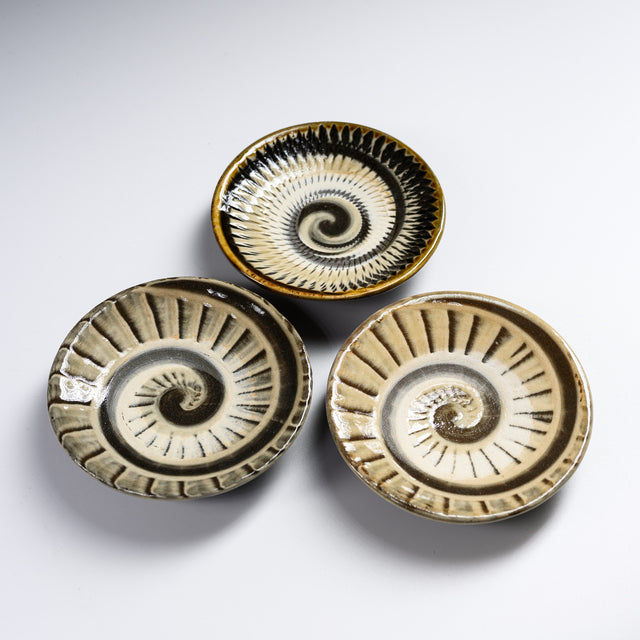
It is then decorated using Onta's signature techniques, such as tobikanna (飛び鉋), where a curved metal blade creates rhythmic patterns on the rotating clay. Another technique, uchi-hakeme (打ち刷毛目), uses a brush to create patterns in white slip, a liquid clay coating applied to the surface of the piece. The brush marks create subtle variations in tone.

The pieces are then fired in a traditional climbing kiln.

An Onta potter shaping clay on the wheel
↑ shaping on the wheel
↑ tobikanna
↑ a spiral, drawn on the turning clay
04受け継がれる伝統

A tradition carried forward

Onta Ware has been passed down through families for around 300 years, with techniques handed from parent to child. Today the village's kilns work together to preserve it as a tradition of the whole community, not simply the work of one maker.

That tradition also drew the attention of the Mingei folk craft movement, and the British potter Bernard Leach visited Onta, where he spent time working alongside the village's potters. After all these years, the water still moves the pestles, the clay still comes from the mountains, and the kilns still burn.

↑ a hakeme large plate
↑ tobikanna small bowl
↑ hakeme with a circular pattern
↑ a spiral small plate
Our picks

Featured pieces

Tobikanna Small Plate – 10 cm / 小皿

Onta Ware Tobikanna Small Plate - 10 cm - 4 Options / 小鹿田焼 小皿
A small plate with the chattering tobikanna pattern, in four options.
Discover this piece

Tobikanna Small Bowl – 11 cm / 小鉢

Onta Ware Tobikanna Small Bowl - 11 cm - 4 Options / 小鹿田焼 小鉢
An everyday bowl for side dishes, pickles or sweets.
Discover this piece

Hakeme Small Plate – 10 cm / 小皿

Onta Ware Hakeme Small Plate with Circular Pattern - 10 cm - 4 Options / 小鹿田焼 小皿
Brushed slip in a circular pattern, in four options.
Discover this piece

Spiral Small Plate / 小皿

Onta Ware Spiral Small Plate - 3 Options / 小鹿田焼 小皿
A spiral drawn on the turning clay, in three options.
Discover this piece
The climbing kiln in Onta village
About the maker

ONTA WARE / 小鹿田焼

Onta ware (小鹿田焼) has been made in a small village in the mountains of Oita for around 300 years. Clay from the surrounding mountains is pounded by water-powered karausu (唐臼), shaped by hand, decorated with techniques such as tobikanna and uchi-hakeme, and fired in a traditional climbing kiln.

The techniques have been handed down from parent to child, and the village's kilns work together to keep Onta ware alive as a tradition of the whole community.
Meet the maker's collection
Living with it

Use & care

Onta ware is made to be used every day. A little care helps it age beautifully.

  • Before first use, soak the piece in water for a while, then let it dry.
  • Hand wash with a soft sponge and mild detergent, and dry thoroughly before putting away.
  • Avoid the dishwasher, and avoid sudden changes in temperature.
  • Avoid leaving the piece soaking in water for long periods, as moisture can be absorbed into the clay and may cause staining or mould if the piece is not dried properly.
  • Check the care instructions for your specific piece before using a microwave or oven, as suitability varies by product. Do not use the piece over a direct flame.
  • Small variations in glaze and pattern are part of the handmade character.