Skip to content
The Osara Journal

Kutani ware: 九谷焼A Celebration of Colour

Gold-outlined flowers, deep flowing glazes and raised, textured patterns — four expressions of Japan's most colourful porcelain.

Read the story

Kutani ware (九谷焼) is a porcelain from Ishikawa Prefecture, first made around 1655 and loved ever since for its rich, soulful colours.

Each piece begins with delicate lines drawn in Gosu (呉須) — a deep indigo blue that breathes life into the design. Then the traditional Five Colours (五彩) — red, green, yellow, purple and deep blue — are layered on with a gentle thickness, creating a texture that is as warm as it is beautiful.

Over the centuries, Kutani artisans have developed many distinct styles. Here are four of the most distinctive, and the pieces we've chosen from each.

Gosu's deep indigo lines lay the foundation for Kutani's many distinctive decorative styles.
01花詰 ― 器を埋め尽くす花々

Hanazume: a bouquet on every surface

Introduced in the Taisho era (1912–1926), Hanazume (花詰) is a breathtaking technique in which the whole vessel is enveloped in a dense bouquet of flowers. Each bloom is delicately outlined in gold, creating a vibrant and luxurious beauty.

Turn a Hanazume piece in your hands and you'll keep finding new flowers — peonies, chrysanthemums and small blossoms tucked between them, each painted by hand.

Kutani ware cup covered in Hanazume flowers outlined in gold
↑ every flower outlined in gold
Kutani ware Hanazume lidded incense burner beside its signed wooden box
↑ comes with a signed wooden box
Pair of Kutani ware mugs with Hanazume flowers on a textured dark glaze
02彩釉 ― 流れるような色の重なり

Saiyu: colour in motion

Saiyu (彩釉) is a technique in which Kutani's representative colours are applied as an overglaze across the entire vessel. By layering two or more colours, the piece reveals a gradual transition of hues, so you can appreciate the depth and movement of the glaze.

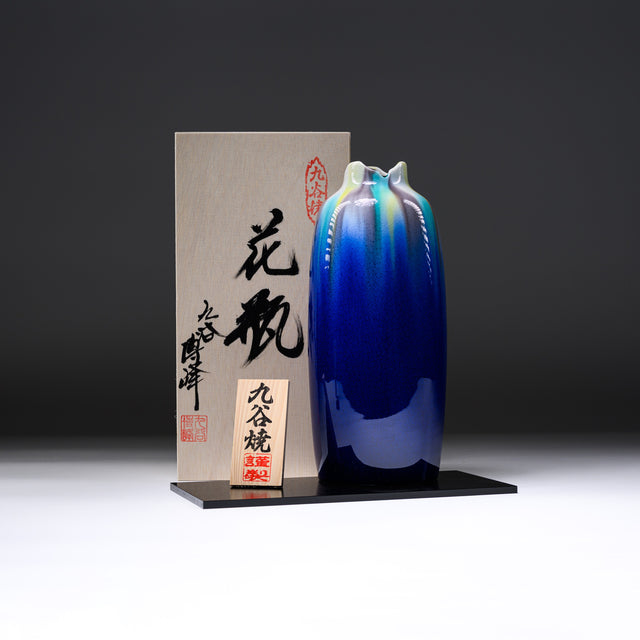
Shibata Hiroshi's work is especially known for its captivating gradation of deep blue, creating an almost immersive sense of depth. His elegant use of colour is highly regarded.

Shibata Hiroshi Kutani ware vase glazed in flowing Saiyu blues
↑ deep blue, layer upon layer
Shibata Hiroshi Saiyu vase standing beside its signed wooden box
↑ signed by the artist
Pair of Shibata Hiroshi Saiyu tea cups with blue, yellow and grey gradation
03盛絵付 ― 触れて感じる立体の模様

Morietsuke: patterns you can feel

Also originating in the Taisho era, Morietsuke (盛絵付) is celebrated for its dynamic, textured patterns. Designs are built up with thick, specialised glazes so they stand out from the surface, giving each piece a powerful sense of character and a sophisticated, artisanal depth.

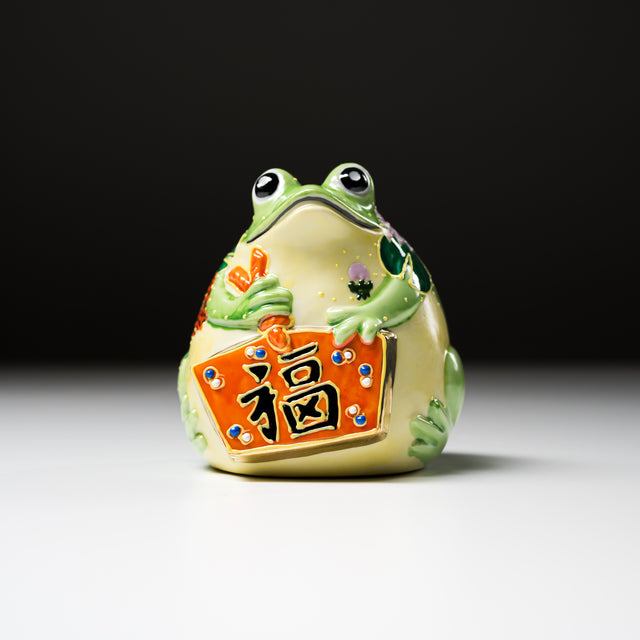
The technique brings Kutani's lucky animals to life — beckoning cats that invite good fortune, and frogs carrying the character for happiness (福).

Pink Kutani ware cat ornament decorated with raised Morietsuke flowers
↑ raised flowers you can feel
Pair of Kutani ware lucky cats on a red and black stand
↑ a lucky pair
Kutani ware happiness frog ornament held in the palm of a hand
↑ 福 means happiness
04尾長 ― 福を運ぶ鳥

The Onaga: a bird of good fortune

The Onaga, or long-tailed bird, is a traditional motif associated with good fortune and auspicious wishes in Japanese design.

Today, the Onaga motif appears across a range of Kutani ware, from mugs and teapots to sake sets and matcha bowls, carrying its message of happiness and good fortune into everyday life.

Pair of white Kutani ware mugs painted with the Onaga blue bird and blossoms
↑ the Onaga among spring blossoms
Kutani ware Kacho Fugetsu sake set painted with the Onaga blue bird
Our picks

Featured pieces

Lidded Incense Burner – Hanazume / 花詰 香炉

Kutani Ware Premium Incense Plumpy Burner Container - Hanazume - Nakata Ryuzan / 九谷焼 香炉 中田龍山
Covered in gold-outlined flowers, painted by Nakata Ryuzan, with a signed wooden box.
Discover this piece

Shibata Hiroshi Vase – Saiyu / 彩釉

Kutani ware Vase with Wooden Gift Box - Shibata Hiroshi - Saiyu / 九谷焼 花瓶
Layers of deep blue overglaze that seem to move as the light changes, in a signed wooden box.
Discover this piece

Happiness Frog Ornament / 福

Kutani Ware Animal Ornament - Happiness Frog / 福カエル
A raised Morietsuke frog holding the character for happiness, small enough to sit in your palm.
Discover this piece

Pair Mug Cup – White Kacho / 花鳥

Kutani ware Pair Mug Cup - White Kacho / 九谷焼 ペアマグカップ
The Onaga blue bird among blossoms, on a pair of everyday mugs.
Discover this piece

Matcha Bowl – Kacho Fugetsu / 抹茶碗

Kutani ware Premium Matcha Bowl - Kacho Fugetsu / 九谷焼 抹茶碗
A yellow-glazed bowl with the Onaga and spring blossoms, presented in a wooden box.
Discover this piece
About the maker

KUTANI Ware / 九谷焼

Kutani ware takes its name from the village of Kutani in Ishikawa Prefecture, where it originated around 1655. After its early production came to an end, the tradition experienced a hiatus of approximately a century before being revived in the early 19th century, and it has been made continuously ever since.

Today, Kutani ware is created by family workshops and individual artists across southern Ishikawa, among them Nakata Ryuzan and Shibata Hiroshi, whose work features on this page. Each piece is painted by hand, and the finest come in a wooden box signed by the artist.
Meet the maker's collection
Living with it

Use & care

Kutani ware is made to be used and enjoyed. A little care keeps its colours bright for generations.

  • Hand wash gently with a soft sponge and mild detergent. Avoid scourers, hard sponges and abrasive cleaners, as they may scratch the surface or damage the painted decoration.
  • Hand washing is recommended to protect the decoration. Check the individual product's care instructions before using a dishwasher or microwave, as suitability may vary depending on the piece and its decoration.
  • Avoid using items with gold or silver decoration in the microwave, as the metallic decoration may react to microwaves and cause sparking.
  • Avoid sudden temperature changes, as they may cause the ceramic to crack.
  • Dry thoroughly before storing, as moisture left on the surface may lead to mould or unpleasant odours.
  • For ornaments, gently remove dust with a soft, dry cloth to protect the surface and painted details.