Skip to content
The Osara Journal

Kobei Kiln: 幸兵衛窯Persian Blue at Christmas

A kiln founded in 1804 revived an ancient blue from West Asia, giving this historic colour a new place in Christmas celebrations.

Read the story

Christmas has its familiar colours: warm reds, deep greens, soft whites and touches of gold. But blue can bring a different feeling to the season.

At Kobei Kiln (幸兵衛窯), this distinctive colour is Persian blue (青釉), a blue whose story reaches far beyond Christmas, with roots in ancient West Asia.

Here is how a kiln in Gifu came to make it, and how it found its way onto a Christmas tree.

An ancient blue, reimagined through time.
01古代西アジアに遡る青

A blue with ancient roots

Persian blue has its origins in ancient West Asia, where copper was used as a colouring agent to create this distinctive blue. In the desert landscapes of the region, blue naturally evoked the colour of water and became associated with life.

Centuries later, this blue became part of the story of Kobei Kiln, founded in Tajimi, Gifu, in 1804. The sixth-generation potter Kato Takuo (加藤卓男) developed a deep interest in ancient Persian ceramics and spent many years researching them. Through his studies in Europe and Iran, he worked to revive ceramic techniques that had been lost over time, including Persian blue.

A row of Kobei Kiln Persian blue Egyptian god figures
↑ the Persian blue family, side by side
↑ layers of glaze, up close
↑ the Venus vase, held in the hand
02幾層にも重ねる釉薬の深み

More than a colour

Persian blue's depth comes from more than its colour. To create this rich blue, the glaze is applied four to five times, so its depth and character develop gradually.

The same blue can look completely different depending on the form it takes. One of Kobei Kiln's most striking expressions is its series of guardian figures inspired by ancient Egyptian mythology, such as Horus, Sobek and Sekhmet, where the blue becomes part of each figure's character and the story it carries.

Kobei Kiln Horus figure glazed in Persian blue with gold details
↑ Horus
Kobei Kiln Sobek crocodile figure in Persian blue
↑ Sobek
↑ Sekhmet
↑ Khnum
↑ Bastet in blue-black
03クリスマスを彩る青釉

Persian blue for Christmas

In the Christmas Series, Persian blue takes on familiar festive forms: Christmas trees and Santa Claus, angels, snowmen and little houses.

Each ornament is handmade and hand-painted in Japan, with delicate details and gentle expressions. Some hold little surprises to discover, such as removable lids or tiny ceramic presents tucked inside. A blue with roots in the ancient world, now finding its place in the Christmas season.

Kobei Kiln Christmas ornaments together
↑ the Christmas series together
↑ tiny ornaments on a ceramic tree
↑ Blue Santa and his reindeer
↑ a little gift hidden beneath the roof
↑ Angel
04暮らしの中で楽しむ青

Blue for the table

Beyond ornaments, Kobei Kiln brings the same craft to pieces for everyday life: rectangle plates painted with horses and flowers, tall Persian blue vases presented in wooden boxes, and cups and saucers in the Sancai and Rancai styles.

In 2026 the kiln also marked its 222nd anniversary with a commemorative plate covered in cats, a playful reminder that a 200-year-old kiln can still surprise.

↑ horse and flowers, drawn by hand
↑ presented in a wooden box
↑ a Rancai-style cup and saucer
↑ the 222nd anniversary plate
Our picks

Featured pieces

Christmas Series – Blue Santa and Reindeer / 青釉
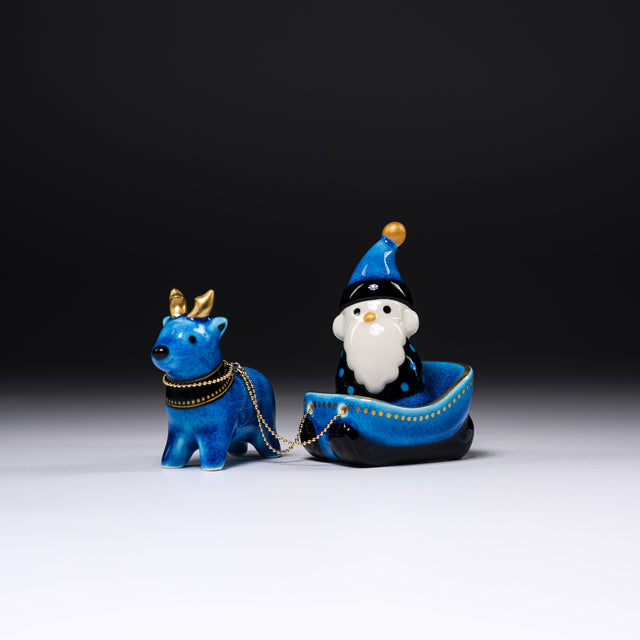
KOBEI Kiln Christmas Series - Blue Santa Claus and Reindeer Ornament / 幸兵衛窯 青釉クリスマスオーナメント
Santa and his reindeer in deep Persian blue: a Christmas piece you can leave out all year.
Discover this piece

Christmas Series – Santa Claus and Reindeer
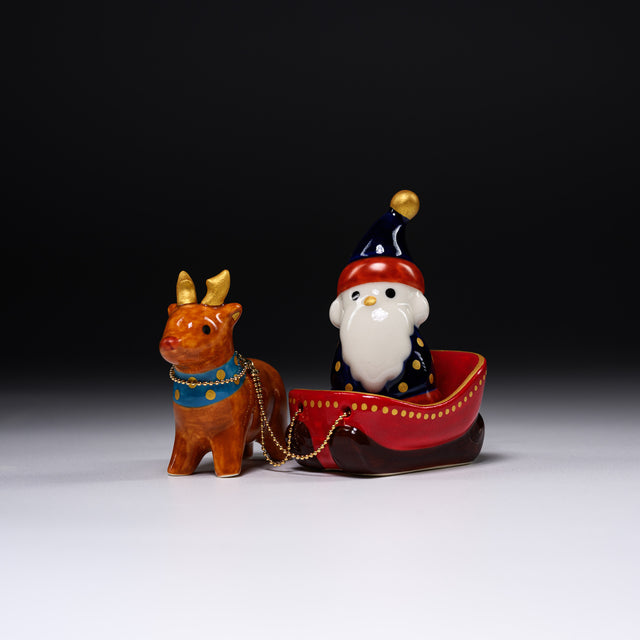
KOBEI Kiln Christmas Series - Santa Claus and Reindeer Ornament / 幸兵衛窯 クリスマスオーナメント
The same pair in festive red and gold, each hand-painted with its own expression.
Discover this piece

Christmas Series – Little House with Present
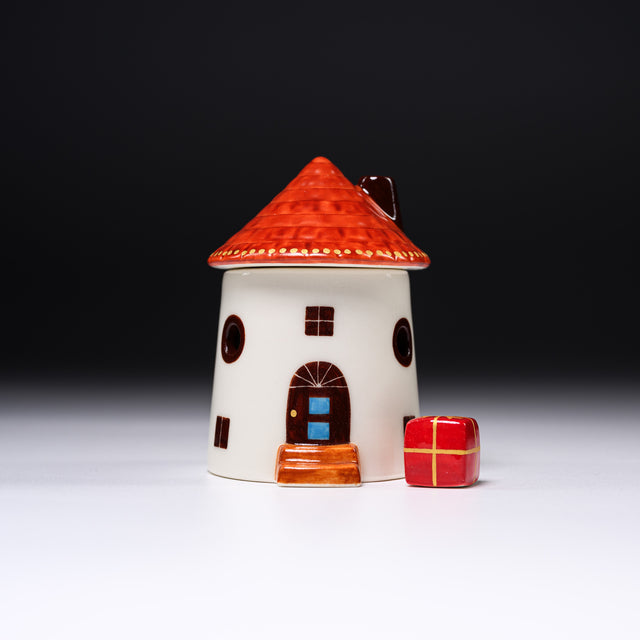
KOBEI Kiln Christmas Series - Little House with Present Ornament / 幸兵衛窯 クリスマスオーナメント
Lift the roof to find a tiny ceramic present tucked inside.
Discover this piece

Premium Vase – Venus / 青釉花器

KOBEI Kiln Premium Vase with Wooden Box - Venus / 幸兵衛窯 青釉花器
A tall vase in Persian blue that deepens where the glaze pools, presented in a wooden box.
Discover this piece

Bastet – Blue Black / オーナメント

KOBEI Kiln "The Egypt 9 Glory Gods" Ornament - Bastet - Blue Black / 幸兵衛窯 青釉オーナメント
The cat goddess Bastet in glossy blue-black, with hand-painted gold details.
Discover this piece
About the maker

Kobei Kiln / 幸兵衛窯

Founded in 1804 in Tajimi City, Gifu Prefecture, Kobei Kiln (幸兵衛窯) has long played a vital role in preserving the Mino ware tradition and once served as an official supplier to Edo Castle. Now led by the eighth-generation Kato Ryotaro (加藤亮太郎), the kiln has earned global acclaim—including recognition as a Living National Treasure—for its exceptional craftsmanship and revival of ancient techniques. The kiln continues to shape future artisans—each piece is handcrafted and hand-painted under the potter’s supervision, carrying the spirit of generations past while allowing for individual expression.
Meet the maker's collection
Living with it

Use & care

Kobei Kiln pieces are made to be enjoyed for many years. A little care keeps the glaze glowing.

  • Ornaments and figures: Gently remove dust with a soft, dry cloth.
  • Plates, cups and vases: Hand wash with mild detergent and a soft sponge. Rinse thoroughly and dry completely before storing.
  • Pieces with gold details: Do not use in the microwave, as the metallic decoration may cause sparks. Hand washing is recommended to protect the decoration. Avoid using the dishwasher.
  • Pieces with small parts: Handle lids and small decorative pieces carefully. Keep the original storage box for safe storage, where provided.